

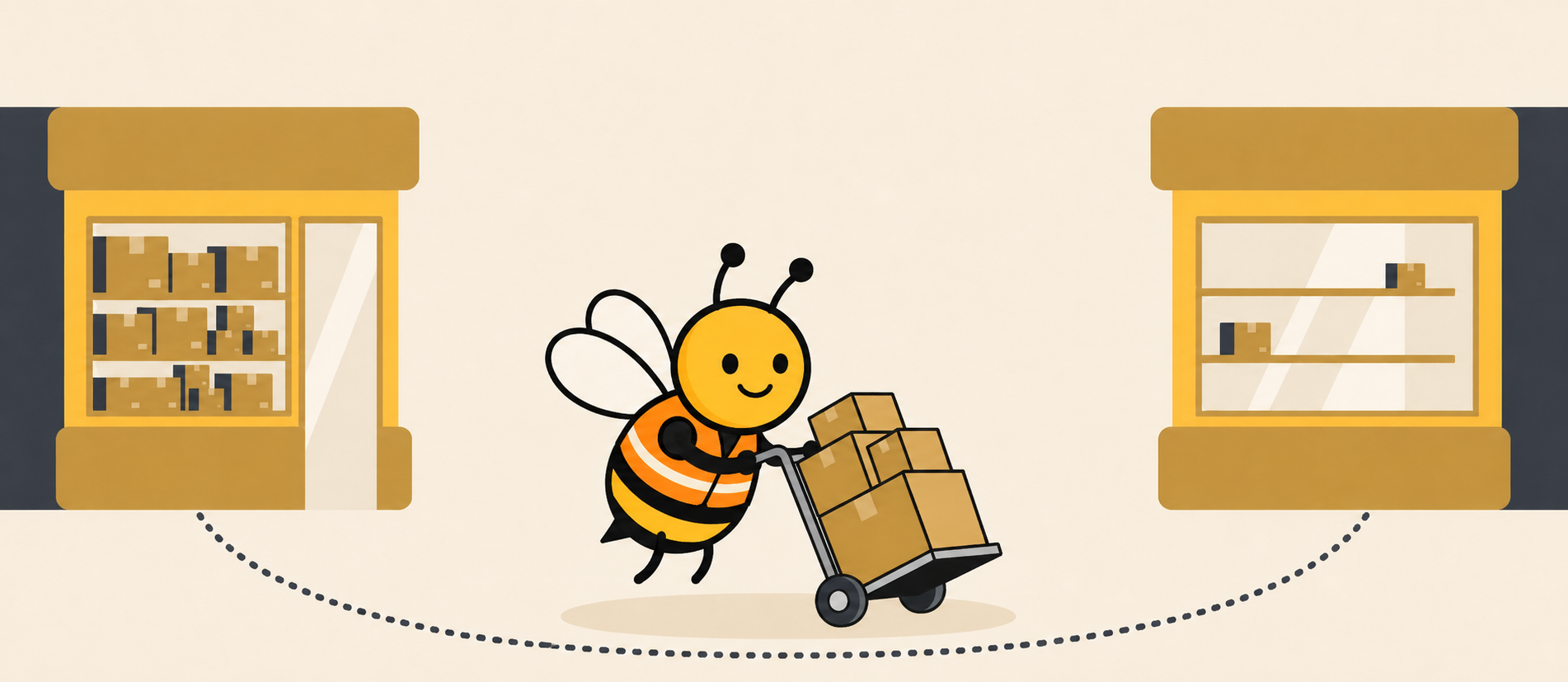
Your Toronto location just sold out of your best-selling hoodie in medium. Someone on the team does what they always do: opens a purchase order and reorders. Meanwhile, forty mediums of that exact hoodie sit untouched on a shelf in Ottawa, where they’ve sold twice this month.
The store had plenty of stock. Just none of it where the buying was happening.
Most multi-location merchants pay this tax every reorder cycle without ever seeing the invoice. The cost of overstocking one location while another runs dry doesn’t show up as a line item anywhere. It hides in cash flow, in markdowns, in forecasts that quietly drift wrong. This post puts numbers on it, then shows you how to find it in your own store this week.
“The store had plenty of stock. Just none of it where the buying was happening.”
Why merchants reorder stock they already own
Nobody does this on purpose. It happens because the reorder path is paved and the transfer path isn’t:
- Each location manages its own stock in its own silo, so the person placing the PO never sees the surplus sitting one province over.
- Shopify’s admin shows you a company-wide total, and a healthy total can hide a badly lopsided distribution underneath it.
- Reordering has a routine. Someone owns it, there’s a supplier, there’s a rhythm. Moving stock between your own locations usually has no owner at all.
- A transfer feels like admin work. A purchase order feels like progress.
So the surplus stays put, the PO goes out, and the business buys demand it had already paid for.
The four costs of the overbuy tax
1. Cash tied up twice
Run the math on that hoodie. Forty surplus units at an $18 landed cost is $720 already spent, sitting idle in Ottawa. The reorder for Toronto spends fresh cash against the same demand. One SKU, one cycle, and you’ve funded the same sales twice.
That number looks small until you multiply it across a catalogue. A store with 800 active SKUs and even a modest imbalance rate can have five figures parked in duplicate inventory at any given moment. That’s money that could be funding new product, ad spend, or payroll. Instead it’s holding shelves down.
2. Carrying costs on stock that doesn’t move
Idle inventory isn’t free to keep, either. Every surplus unit accrues storage space, insurance, handling, shrink, and the opportunity cost of the capital locked inside it. The exact rate varies too much by business to pin a universal number on, but the direction is always the same: the longer stock sits where it isn’t selling, the more it costs to own.
And surplus created by overbuying sits longer than most, because the demand it was meant to serve is being filled by the new PO at the other location.
3. Markdowns at the surplus location
Eventually, slow stock gets discounted where it sits. The same hoodie that sold at full price in Toronto goes 30% off in Ottawa to clear shelf space, and the margin difference comes straight out of profit.
This isn’t a small-merchant quirk. IHL Group, which has tracked the cost of out-of-stocks and overstocks for 18 years, put the global cost of overstocks at $554 billion in 2024, driven largely by excess discounts and spoilage. Their 2025 research found inventory distortion as a whole (overstocks plus out-of-stocks) still eats roughly 6.5% of global retail sales. Markdown pressure on misplaced stock is one of the main ways that loss shows up.
“Overstocks cost retailers $554 billion globally in 2024. Most of it leaks out through discounts on stock that was simply in the wrong place.”
4. The forecast you just poisoned
This one compounds quietly. The Toronto location, stocked out, records fewer sales than it could have made. The Ottawa location, oversupplied, records slow movement. Both signals are now wrong, and both feed your next round of buying decisions.
So the next PO over-orders for the slow location and under-orders for the fast one, and the imbalance you started with gets rebuilt on purpose. Out-of-stock days distort demand data in ways most merchants never correct for. We’ll cover that properly in an upcoming post on forecasting. [Internal link: B03 when live]
How to spot the overbuy tax in your own store
You don’t need software to find this. An hour with a spreadsheet will do it:
- Export your top 20 SKUs with on-hand quantity by location, alongside the last 60 days of sales by location.
- Flag any SKU holding 60+ days of cover at one location while another sits under 14 days. That’s your imbalance list.
- Pull last month’s purchase orders and cross-reference. Count every reorder that overlapped with surplus of the same SKU somewhere else in the business.
- Price it. Surplus units times landed cost equals the cash you bought twice.
Most merchants who run this exercise find at least a handful of overlaps in the first pass. The number at the end of step four is your overbuy tax for the month. Annualize it and the case for fixing the problem usually makes itself.
“Surplus units times landed cost equals the cash you bought twice.”
Transfer first, reorder second
The fix is a habit before it’s a tool. Before any purchase order goes out, ask one question: does this stock already exist somewhere in the business? If it does, a transfer is almost always cheaper than a PO. You’ve already paid for the units, the margin is already banked, and the only new cost is moving them.
The manual version is the spreadsheet check above, run before every reorder cycle. It works. It also takes discipline that tends to erode during busy seasons, which is exactly when imbalances do the most damage.
That’s the gap BeeBalanced was built for. It reads stock and forecasted sales for every product at every location, then generates the transfers that rebalance them, created as draft transfers in Shopify you can review, edit, or delete before anything moves. Prefer to work outside Shopify’s transfer flow? Export the same data to CSV instead. Adjustable settings shape the transfers to fit how your business actually runs.
Every avoided overbuy is cash back in the business this quarter, not someday.
Run the spreadsheet check this week, and if you’d rather the check ran itself, start the 14-day free trial and see where your stock should already be.